23x5 Stock Trading Is Coming: What Public Companies Need to Know
On April 10, 2026, the Securities and Exchange Commission (“SEC”) approved a Nasdaq Stock Market (“Nasdaq”) proposal to extend its trading hours to 23 hours per day, five days per week (“23x5 trading”). The following month, the New York Stock Exchange (“NYSE”) amended a prior rule filing to set forth its own framework for 23x5 trading on NYSE Arca, a fully electronic exchange that is the primary U.S. listing venue for exchange-traded products such as ETFs and that also trades stocks listed on the NYSE and other U.S. exchanges. Although the exchanges have designed slightly different models, both will add an overnight trading session to achieve nearly continuous 23x5 trading.
The extended trading hours are expected to launch on December 6, 2026, subject to additional SEC approvals and necessary infrastructure updates. The extended trading hours will affect all public companies with securities listed on a national securities exchange, even if their primary listing exchange does not operate on an extended trading model, as any National Market System (“NMS”) stock, including NYSE and NYSE American-listed stocks, can be traded on NYSE Arca.
In this Client Alert, we summarize the changes to achieve 23x5 trading, highlight implications the extended trading hours may have for public companies, and recommend steps public companies can take to accommodate the new models.
Extended Trading Hours Overview
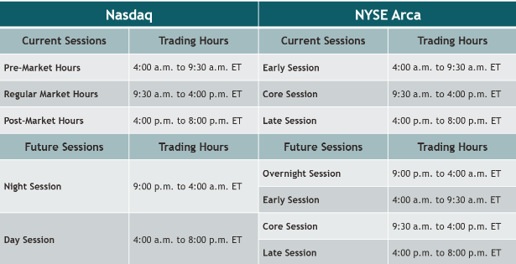
Both exchanges currently operate three trading sessions each weekday: (1) 4:00 a.m. to 9:30 a.m. ET, (2) 9:30 a.m. to 4:00 p.m. ET, and (3) 4:00 p.m. to 8:00 p.m. ET. Additionally, trade clearance and system maintenance are handled during the daily pause. To achieve the extended trading hours, both exchanges will add an overnight trading session from 9:00 p.m. to 4:00 a.m. ET.
With the addition of the overnight session, the new trading week will start on Sundays at 9:00 p.m. ET and end on Fridays at 8:00 p.m. ET, with a compressed one-hour trading pause to run each day from 8:00 p.m. to 9:00 p.m. ET. The mandatory one-hour trading pause will still allow for trade clearance, system maintenance, corporate action processing, and transition to the next trade day. To accommodate holidays and other days when an exchange is closed for business, the market will close at 8:00 p.m. ET on the calendar day before the closure date and reopen at 9:00 p.m. ET on the closure date. If the closure date falls on a Friday, trading will resume on Sunday at 9:00 p.m. ET.
The new overnight session will open with continuous trading rather than an opening auction and, like the current pre- and post-market sessions on both exchanges, will have limited functionality. For instance, there will be fewer order types available and only U.S. broker-dealers who are members of the relevant exchange will be permitted to trade during the overnight session. Further, because the overnight session will span two calendar days, any trades made between 9:00 p.m. and 11:59 p.m. ET will be reported with the next calendar day’s trade date, and any trades made between midnight and 4:00 a.m. ET will carry the current calendar day’s trade date. Settlement terms will continue to be based on trade dates as they are today.
Although both exchanges will add an overnight session to achieve 23x5 trading, each exchange has designed a slightly different model. The Nasdaq model will consist of a two-session trading framework. First, Nasdaq will add an overnight session, referred to as the “Night Session.” Second, Nasdaq will consolidate the current pre-market, regular market, and post-market hours into a single “Day Session” from 4:00 a.m. to 8:00 p.m. ET. Within the Day Session, Nasdaq will continue to hold its Opening and Closing Crosses at 9:30 a.m. and 4:00 p.m. ET, respectively, and regular market hours will continue to run from 9:30 a.m. to 4:00 p.m. ET.
In contrast, the NYSE Arca model will simply add a fourth trading session, referred to as the “Overnight Session.” NYSE Arca’s existing three sessions will remain largely unchanged, meaning the regular market will still open at 9:30 a.m. ET, and the exchange will continue to hold its Early Open, Core Open, and Core Closing Auctions.
The current and future trading sessions are summarized in the table below.
Corporate Actions and the Regulatory Halt
One concern raised by the extended trading hours is that the one-hour trading pause may not provide sufficient time to process certain complex corporate actions. To alleviate this concern, national exchanges, including NYSE and Nasdaq, have proposed to expand their regulatory halt rules. A regulatory halt will be triggered by the following complex corporate actions: (1) changes in the issuer’s trading symbol; (2) changes in the issuer’s CUSIP number; (3) certain large stock dividends; (4) forward and reverse stock splits; (5) de-SPAC transactions; (6) spin-off transactions; (7) security-type changes; (8) mergers or similar mandatory exchanges of shares; and (9) any other corporate action or issuer-related event for which the primary listing exchange determines that a halt is necessary or appropriate to maintain fair and orderly markets, protect investors, or otherwise serve the public interest.
If the primary listing exchange determines that a halt is triggered, the one-hour trading pause will extend through the entire overnight session on any exchange that would otherwise trade overnight, until trading resumes on the primary listing market. As a result, the proposed regulatory halt rules would effectively preserve the current trading framework and provide adequate time to process the changes before the effective date of the corporate action.
Considerations for Public Companies
As mentioned, public companies with securities listed on a national securities exchange will be affected regardless of their primary listing market. However, the degree of this impact is currently unknown and will largely depend on market behavior and whether overnight trading becomes significant. Despite this uncertainty, issuers cannot opt out of 23x5 trading, so public companies may want to take certain actions before the extended trading hours take effect.
Definitions in Corporate Policies
Companies may need to amend or clarify corporate policies that reference exchange-based definitions. Nasdaq-listed companies should review their insider trading policies and trading windows for references to exchange-defined sessions because the consolidation of the current sessions into a single Day Session could create ambiguities. For instance, terms like “Nasdaq market hours” or “market close” that do not reference a specific time of day could leave a policy open to arguments that it refers to the entire Day Session. Other policies and equity plans that reference exchange-defined sessions or use terms like “fair market value” may also need to be clarified to address how they will be interpreted in light of 23x5 trading.
NYSE-listed companies, on the other hand, will likely experience little to no change because the current trading sessions will largely be preserved. In either case, companies should review their existing policies and plans and address any ambiguities based on the specific policy or plan language.
Transaction Documents
Similarly, companies should review any agreements or offering documents that reference exchange-based definitions or were drafted with current trading hours in mind. For instance, terms like “trading day” or “market close” may need to be clarified in light of 23x5 trading.
Disclosure Practices
Extended trading hours do not directly alter disclosure or reporting obligations, and in the immediate term, we expect that practice regarding earnings releases to continue without significant changes. However, in connection with adoption of the 23x5 trading, public companies should review how and when they release material information. Currently, issuers tend to make filings and publicize material information after the close of regular trading hours, which gives the market time to absorb the information before the next trading day, and tend to release earnings before the opening of regular trading (while acknowledging that their stock continues to trade in pre-market and post-market sessions or alternative trading systems and foreign exchanges). Extended trading hours could mean that such information will be released into a live exchange market. This may be especially relevant if a company is experiencing high overnight trading volume. Accordingly, as market behavior develops, or if a company-specific development is expected to affect overnight trading volume, companies may need to rethink their longstanding practice of disclosing material information outside of regular trading hours. Further, it remains unclear whether the SEC will need to extend EDGAR filing hours to accommodate such changes in disclosure practices.
Market Dynamics
Longer trading days and increased trading activity during nontraditional hours may alter risk assessment and the structure of capital markets transactions. For instance, extended trading hours increase the window in which leaked information can affect trading price before a deal team can react. Additionally, significant overnight trading volume could affect certain aspects of overnight marketed offerings that have been structured around a period when stocks are not trading. Although the magnitude of this risk will largely depend on overnight trading volume, public companies should monitor it as the market evolves.
Conclusion
Ultimately, the extended trading hours reflect an attempt to broaden investor access and enable issuers to attract capital more efficiently across the globe while preserving many familiar market protections. Although adding the overnight session is not expected to immediately result in a significant overnight market, it is expected to shape public company practices over time and has been viewed as the next step toward continuous trading. As a result, public companies should be aware that their shares may trade overnight and that they may need to conform their existing policies and documents to the extended trading hours. While disclosure practices may not immediately change in a significant manner, companies should monitor market behavior and adjust their procedures accordingly.
If you have any questions related to this legal alert, please do not hesitate to contact any member of the Public Companies group or your regular Smith Anderson lawyer.
Special thanks to contributing author Margot Porter, Smith Anderson intern and J.D. candidate at the University of North Carolina School of Law.
Professionals
 Attorney
 Attorney
 Attorney
 Attorney